
What Is the Major Richard Star Act? The Wounded Veteran Tax, Explained
America's toughest warriors are still fighting—but now it's against Congress.
Updated September 2026. Originally published July 25, 2025. Every statistic below has been re-checked against congress.gov, CBO reporting, MOAA, and the House Veterans' Affairs Committee.
Looking for the current legislative status? On Sept. 15, 2026, a discharge petition hit 218 signatures — enough to force a House floor vote. The House left town the next day without holding one. → Major Richard Star Act vote status: 218 signatures, still no vote
This page is the standing explainer: what the offset is, who Chapter 61 retirees are, what the bill costs, and why any of it matters.
What the Major Richard Star Act Does
The Major Richard Star Act (H.R. 2102 / S. 1032) would end the dollar-for-dollar offset that cancels military retirement pay against VA disability compensation for Chapter 61 retirees — service members medically retired with fewer than 20 years of service because of a combat-related injury. Today they effectively trade one earned benefit for the other. The bill lets them keep both.
That's the whole bill. Everything below is why it hasn't passed.
The Cruel Mathematics of Sacrifice
Imagine surviving the unimaginable, only to discover that your own government views your wounds as a financial liability.
Marine Veteran Jamel Daniels wakes up each day, stepping out on one leg—the other lost to an IED blast on the last day of his tour in Iraq. Sixteen months of rehab, a 2006 medical retirement, and every month since, the government claws back retirement pay he earned in blood (MOAA).
Army Sergeant Emil Hirsch was medically retired after being wounded by an IED in Iraq in 2006. He served with the 327th Signal Battalion, 35th Signal Brigade (Airborne), in Afghanistan, and with the 101st Airborne Division in Iraq. He never reached the arbitrary 20-year mark before the enemy reached him, so the offset applies to him too. Writing on Military.com, he put it plainly: the roughly 50,000 veterans medically retired from combat with less than 20 years of service "have been left behind by our country and forced to sacrifice yet again."
Major Richard Star, U.S. Army Reserve, a combat engineer who cleared IEDs in Afghanistan and Iraq, was diagnosed with stage 4 metastatic lung cancer linked to burn-pit exposure just after Memorial Day 2018 and medically retired short of 20 years. He spent his final months working the halls of Congress to end the offset that cut his own retirement check — struggling, out of breath, to reach members' offices — until his death on Feb. 13, 2021, at 51.
 Maj. Richard Star pictured with his daughters earlier in his Army career. (Star family's personal archive)
These warriors are among the Chapter 61 retirees forced into a cruel financial trade-off: every VA disability dollar earned through sacrifice comes directly out of their retirement pay. How many of them there are is genuinely disputed — the estimates run from roughly 54,000 to 60,000, and I lay out who says what further down.
This isn't just unfair—it's morally bankrupt.
The Wounded Veteran Tax: How Chapter 61 Retirees Get Cheated
Understanding the Offset
The current system forces combat-wounded veterans into an unconscionable choice:
- Option A: Take your VA disability compensation for service-connected injuries
- Option B: Keep your military retirement pay that you earned through service
You cannot have both. Every dollar received in VA disability compensation is deducted from military retirement pay, dollar for dollar.
This means that while a 20-year retiree with a 50%+ disability rating receives both their full retirement pay and VA disability compensation (thanks to Concurrent Retirement and Disability Pay - CRDP), a warrior wounded in combat before reaching 20 years gets penalized for their sacrifice.
The Wounded Veteran Tax
How the offset penalizes combat-wounded heroes
Dollar amounts below are a round-numbered illustration of the mechanism, not average or actual pay.
20-Year Retiree (50%+ Disabled)
Served 20 years, qualifies for CRDP with 50%+ disability rating
Chapter 61 Combat-Wounded
Medically retired due to combat injuries before 20 years
Loses $3,000/month due to the offset
The Injustice Explained
While 20-year retirees with 50%+ disability ratings receive both their full military retirement pay AND VA disability compensation (thanks to CRDP), combat-wounded veterans who were forced to retire early lose their retirement pay dollar-for-dollar against their disability benefits.
This means wounded warriors are financially penalized for their sacrifice.
The Major Richard Star Act
Would end this offset for combat-injured Chapter 61 retirees. CBO estimates it would restore an average of about $1,450 a month (via Military.com).
The Human Cost
Let's put faces to these numbers:
Captain Ryan Kules, U.S. Army: Was leading a military patrol in Iraq in 2005 when a roadside bomb threw him from his vehicle, severing his right arm and left leg. After being stabilized in Baghdad and airlifted to Germany for emergency surgery, he underwent more than two dozen surgeries at Walter Reed followed by 18 months of rehabilitation. He was medically retired in May 2007, and the law now keeps him from collecting the retirement pay he earned for time served. He serves as a director at the Wounded Warrior Project, working with veterans to overcome trauma through adventure-based learning. (Stars and Stripes)
 Retired Army Capt. Ryan Kules pictured in Iraq weeks before he was seriously injured by a bomb blast in 2005. (Ryan Kules)
Sergeant Adam Kisielewski, USMC: Was just 21 years old when a bomb rigged to a building door detonated in 2005 near Fallujah, Iraq. He and another Marine were searching the building room-to-room after a gunfight with insurgents when the blast occurred—the other Marine didn't survive. The severity of Kisielewski's wounds required amputation of his left arm at the shoulder and his right leg below the knee. Medically retired in October 2006 after more than a year of surgeries and rehabilitation, every VA dollar still cancels a dollar of retirement he earned in uniform. He now runs a nonprofit called NPLB Outdoors (No Person Left Behind), providing outdoor recreational adventures for veterans with disabilities. (Stars and Stripes)
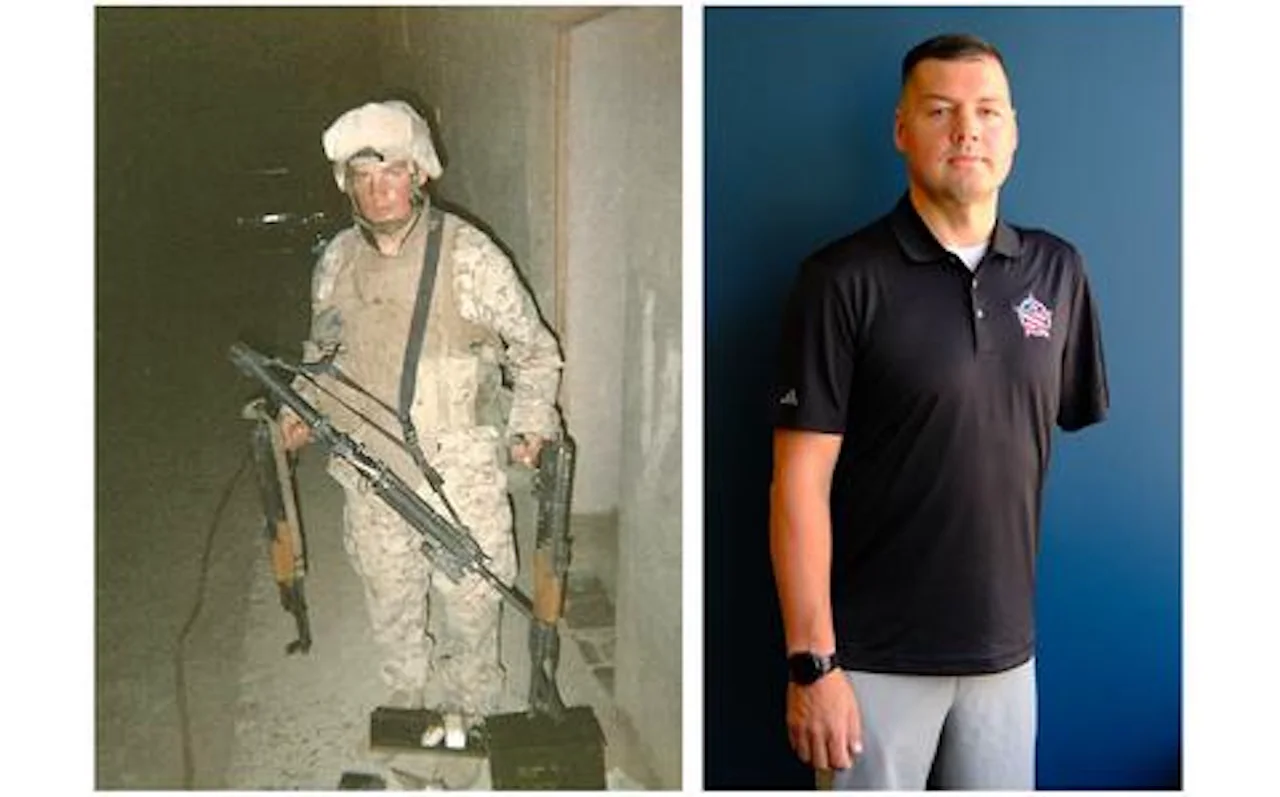 Adam Kisielewski, left, as a Marine Corps sergeant in 2006 just days before suffering life-threatening injuries in a bomb blast in Iraq. Kisielewski, right, in 2024 at the Reserve Organization of America's offices in Washington, D.C. He advocates for the passage of the Richard Star Act. (Adam Kisielewski/Wounded Warrior Project)
Staff Sergeant Latoya Lucas, U.S. Army: Nearly killed on July 21, 2003, when two rocket-propelled grenades hit her two-Humvee convoy in Iraq—the second detonating directly under her seat. The left side of her body was severely burned and her pelvis broken; she spent five months as an inpatient at Walter Reed and still lives with pain, limited mobility and post-traumatic stress. Despite her sacrifices and service-connected disabilities, she sees the offset every year on her DoD statement—a reminder she calls a "long-standing injustice." Lucas continues to advocate for fellow veterans, her financial security compromised by a system that penalizes her for being wounded in service to her country. (DAV)
 SSG Latoya Lucas recovering after being severely wounded by an RPG attack in Iraq in 2003. (DAV)
The Solution: The Major Richard Star Act
The Three Things the Bill Would Do
The Major Richard Star Act (H.R. 2102 | S. 1032) would:
- End the "wounded-vet tax": Fully restore retirement pay alongside disability compensation for Chapter 61 medical retirees
- Provide concurrent receipt: Allow combat-wounded veterans to receive both earned benefits simultaneously
- Honor our promise: Recognize that wounds sustained in service to our nation should never reduce earned benefits
What Does the Major Richard Star Act Cost?
On March 23, 2026, the Congressional Budget Office scored H.R. 2102 as drafted at $78.1 billion in new direct spending over FY2026–2036. Earlier versions had consistently landed between $10 billion and $13 billion (Military Times).
The bill did not get more generous. A sentence got read differently. CBO, working from DoD Office of the Actuary data, concluded the revised language would sweep in roughly 255,000 Chapter 61 retirees under 20 years regardless of how they were hurt; per congressional staff in Sen. Blumenthal's office, the drafters had intended to add about 1,124 people (Military Times).
The version actually queued for a floor vote — the substitute text inside H.Res. 1247 — covers combat-injured retirees only. MOAA puts that at roughly $13 billion over ten years, possibly less, since some retirees would keep tax-free CRSC instead.
Handle that figure carefully, because I am about to do arithmetic on it. $13 billion is MOAA's estimate, not a CBO score. CBO has not scored the substitute language, which means $78.1 billion remains the official number a member of Congress can point at on the floor. Taking MOAA's estimate at face value, $13 billion over ten years works out to about $1.2 billion a year — and every comparison in the next few paragraphs rests on that estimate rather than on a scored figure.
Put that in context. Congress appropriated $839.2 billion for the Department of Defense in FY2026 (CRS R48891), and CBO projects total federal outlays of $7.4 trillion in 2026 (Budget and Economic Outlook: 2026 to 2036). Against those, $1.2 billion a year is about 0.14% of the defense budget and 0.016% of everything the federal government spends — roughly one part in six thousand.
How Much Money Would a Veteran Actually Get Back?
Three different monthly figures circulate, and they measure three different things. Blending them is how bad advocacy math starts.
| Figure | Source | What it actually measures |
|---|---|---|
| ~$1,650/month | The War Horse, citing CBO | The average size of the offset — what gets taken away |
| ~$1,450/month | Military.com, citing CBO | The average net increase a veteran would see |
| $1,200/month | MOAA | The older CBO estimate, from the 118th Congress version of the bill |
The honest number for "money restored" is about $1,450 a month. A veteran electing concurrent receipt gives up CRSC, so the net gain is smaller than the raw offset.
How Many Veterans Are We Talking About?
There is no agreed figure, and anyone who hands you one without a caveat is guessing. The 53,000 that still circulates traces to Stars and Stripes reporting from March 2025. Here is where the estimates stand now:
| Estimate | Source |
|---|---|
| More than 59,000 | House Veterans' Affairs Committee, September 2026 |
| Nearly 59,000 receiving CRSC as of Sept. 2025 | CBO, via Military.com |
| About 54,000 | The War Horse and Military Times |
| Fewer than 60,000 | MOAA |
| Nearly 60,000 | Star Act Alliance |
| About 255,000 | CBO's March 2026 score of the bill as drafted |
That last line is not a rival count of combat-injured retirees. It is CBO's reading of what the revised bill text would cover — every Chapter 61 retiree under 20 years, however they were injured. It measures a drafting error, not a population. The defensible range for the veterans this bill was written for is roughly 54,000 to 60,000.
Who's Behind It in Congress
As of September 2026:
- 339 of 435 House members — 338 cosponsors plus sponsor Rep. Gus Bilirakis (R-FL-12) (H.R. 2102)
- 80 of 100 senators — 79 cosponsors plus sponsor Sen. Richard Blumenthal (D-CT) (S. 1032)
The House Veterans' Affairs Committee and DAV both cite 340 in the House. I'm using congress.gov's count.
Congressional Support
Bipartisan backing for the Major Richard Star Act
As of September 2026. Source: congress.gov — H.R. 2102 and S. 1032.
House of Representatives
Senate
78.3% of Congress backs the bill, and it still has not reached the House floor.
So why hasn't leadership scheduled a vote? That fight has its own post: 218 signatures, still no vote.
"We Can't Afford It"? Try Again, Congress
In July 2025, Congress passed the Rescissions Act of 2025 (P.L. 119-28), cancelling money it had already appropriated. The White House request that opened that fight was $9.4 billion; after the Senate stripped the global-health portion, the enacted package came in at about $9 billion. Whatever you think of it on the merits, it answers one question permanently: when this Congress wants to move ten figures, it moves them in a single summer.
On MOAA's estimate, the combat-injured version of the Star Act costs about $1.2 billion a year. That original $9.4 billion request was worth nearly eight years of it.
The money exists. The backbone does not.
And the $78.1 billion figure now cited as the reason to wait? That is the price of a sentence CBO read more broadly than its authors wrote it. Fixing a drafting error is staff-level work measured in days. It has been used as an excuse measured in months.
If Full Passage Proves Impossible
If the full bill cannot move, there is a narrower and far better documented option: pass the combat-injured-only version.
That is precisely what the substitute text inside H.Res. 1247 does. It applies expressly to a combat-related disabled retiree "with fewer than 20 years of creditable service" — the population the bill was always meant to reach, and the fix for the CBO eligibility problem. MOAA puts the cost at roughly $13 billion over ten years — still MOAA's estimate, still unscored by CBO.
That version is already drafted. It is already attached to a rule. It is sitting on a calendar waiting for one member to stand up and say one sentence.
The Moral Imperative
What Message Are We Sending?
If lawmakers won't fight for our most severely wounded veterans, what message are they sending those still in uniform?
That being wounded in action is somehow less honorable than making it to retirement unscathed?
That your sacrifice to this nation comes with a financial penalty?
That Congress values accounting ledgers more than Purple Hearts?
The Promise We Made
When these warriors raised their right hands and swore an oath, we made a promise in return:
"If you give everything in service to this nation, we will take care of you."
The offset breaks that promise every single month.
In Their Own Words
The impact of this injustice is best captured in the words of those who live it every day:
"I was forced out of the military. The decision on making the military my career was taken away from me. Because of that, I had to forfeit my military retirement pay. We are asking for the same consideration. We did not have a choice about leaving the military."
— Adam Kisielewski, former Marine Corps Sergeant
"As a platoon leader, I was charged with bringing guys home safe. But I was unable to complete that mission. And I had no choice whatsoever in continuing my military career. Having my retirement pay reduced to nothing because I am receiving disability compensation negates my service and commitment."
— Ryan Kules, former Army Captain
"We're asking for something we feel we earned when we were injured."
— Adam Kisielewski
"Every year since I retired, I see the pay that was offset when I receive my end-of-year statement from the [Department of Defense]. We need to fix this long-standing injustice for veterans who had their military careers cut short due to combat-related injuries like myself."
— Latoya Lucas, former Army Staff Sergeant
Lucas was medically retired after suffering a near-fatal blow from a rocket-propelled grenade that hit her Humvee on July 21, 2003. (For more on Lucas' remarkable journey and recovery, read "Here for a reason".)
Take Action Now
1. Contact Your Representatives
Find your representatives: Use Congress.gov to locate your House representative and Senators.
Demand answers:
- "Why aren't you cosponsoring?" is largely moot — 339 House members and 80 senators already are. Ask instead:
- Will you vote for the discharge motion, the rule, and final passage?
- What specifically is stopping leadership from scheduling the floor vote?
- How do you justify the offset to a veteran who was medically retired at 15 years?
2. Use the One-Click Tools
Star Act Alliance: The coalition MOAA co-founded with WWP, VFW, IAVA, DAV, TAPS, PVA and others → staractalliance.org
MOAA's Action Center: Send a letter to your legislators — note that as of September 2026 MOAA's prewritten letter still references the 118th Congress bill numbers (S. 344 / H.R. 1282), so edit it before sending.
3. Read the Bills
House Bill H.R. 2102: Read the full text on congress.gov
Senate Bill S. 1032: Read the full text on congress.gov
4. Share Your Story
Are you one of the combat-injured retirees living under this offset?
Share your story:
- Post on social media with #MajorRichardStarAct
- Contact local media outlets
- Reach out to veteran organizations
- Comment below with your experience
Every voice makes us louder. Every story makes the injustice more real.
Organizations Fighting for Change
Leading the Charge
Military Officers Association of America (MOAA): Primary legislative advocate for the Major Richard Star Act
Iraq and Afghanistan Veterans of America (IAVA): Strong supporter pushing for congressional action
Veterans of Foreign Wars (VFW): Longtime advocate for concurrent receipt expansion
Disabled American Veterans (DAV): Fighting for fair benefits for disabled veterans
Join the Fight
These organizations need your:
- Membership to increase political clout
- Advocacy to amplify the message
- Donations to fund lobbying efforts
- Stories to humanize the issue
The Finish Line is in Sight
Major Richard Star fought until his final breath to end this injustice. He didn't live to see victory, but his name ensures the fight continues.
339 House members. 80 senators. 218 signatures on a discharge petition. The votes are on paper. What's missing is a floor.
Every month this bill sits in limbo, tens of thousands of wounded warriors receive smaller checks than they've earned. Every month Congress delays, families struggle to make ends meet because bureaucrats decided that wounds are worth less than time in service.
The Choice is Clear
Congress can:
Option A: Continue to penalize our most wounded warriors while claiming to "support the troops"
Option B: Pass the Major Richard Star Act and finally keep our promise to those who kept theirs
Finish Major Star's Mission
The morality is clear. The votes are there. The math is the only thing anyone still argues about, and that argument is over one sentence of drafting that staff could fix in a week.
What's missing is the political courage to do what's right.
Contact your representatives today. Make it clear that supporting wounded warriors isn't optional—it's the absolute minimum we owe those who've given everything for this nation.
Keep our promise to warriors who gave everything—but lived to fight another day.
The time for action is now. The cause is just. The warriors are waiting.
Jeremy Cleland is a retired Green Beret Medical Sergeant, AI engineer, and veteran advocate. He continues to fight for those who fought for us through technology, policy advocacy, and unwavering commitment to the warrior ethos.
Tags: #MajorRichardStarAct #Veterans #ConcurrentReceipt #CombatInjured #KeepOurPromise
Additional Resources
- Current status: Major Richard Star Act vote status: 218 signatures, still no vote
- Congressional Bills: H.R. 2102 | S. 1032 | H.Res. 1247
- Take Action: Star Act Alliance | MOAA Action Center
- How the offset works: DFAS — Concurrent Military Retired Pay and VA Disability Compensation (the Chapter 61 special rules are at 10 U.S.C. § 1414(b))
- Contact Congress: Find Your Representative
- Recent Coverage: Military Times - How a $10 billion veterans bill became a $78 billion debate | Stars and Stripes - Combat-injured veterans face new battle at home
- Veteran Stories: DAV - Combat-wounded veteran reflects on how war changed her life


